The labour movement and its dynamics have seen a drastic shift at the turn of the 21st century. Gone are the days of unions solely protesting for the rights of an exhausted labourer outside a smoky coal factory, because now, the fight is the same for the accountant in their office cubicle. The fight, that is, against unfair treatment of the labourer.
THE IMPORTANCE OF UNIONS
In a globalised economy, labour protection is shifting from industry-specific silos to a model of radical interdependence. This interdependence acknowledges that in a globalised world, a victory for one industry is a safeguard for another, and that every industry, regardless of borders, is directly impacted by the actions of others. Labour dynamics in the current epoch are defined by the borderless flow of capital and stark technological shifts. As a result of these shifts, unions are now unified by the force that is globalised capital and by the shared experience of the troubles they face.
Firstly, we should acknowledge why unions are so important. Unions protect workers in the industries they represent, whether it be in transport, manufacturing, or public services. However, in the current day, unique problems arise despite the noble intentions of the unions. For instance, if a rail worker of the London Underground were to go on strike, and the tubes stopped operating for the day, numerous healthcare workers at the National Health Service (NHS) would find it troublesome to head to work and support the British healthcare system. This inadvertently strains the livelihood of these workers.
When unions are separated by industry, cascading effects like such are detrimental to other labourers. If a union with a more unifying approach strives to bridge these gaps and act as an umbrella for workers across all specialisations, this cascading effect can be prevented. While it is the union’s prerogative to prioritize its members, clashing with fellow unions ultimately triggers infighting that fragments the labour movement further.
THE CONVEYOR BELT
Problems arising from the differences in interests of unions and, by extension, the labourers they represent have seen the establishment and fortification of Global Union Federations (GUFs). Across various countries, these federations represent the global workers subject to the industry in which they work. These GUFs ensure that Multinational Companies (MNCs) toe the line when it comes to the matter of labour standards. The way this is done is through Global Framework Agreements (GFAs) with MNCs from the company’s origin country to their workers in other branches across the world.
As such, the work of the GUFs brings about an interesting ‘waterfall’ effect on the global labour force. The reason for this is simple: one worker in one part of the world has a connected interdependence with a worker on the other side of the world. For example, the same worker mining lithium and cobalt in Namibia is dependent on the small-scale smartphone seller in Malaysia. Intense Globalisation has thus reduced the flow of logistics, manufacturing, and supply chains to a conveyor belt, for if one part stalls, the other cannot move forward.
This allows workers all around the world to operate with each other on this conveyor belt with more dignity. Using the connected interdependence inherent to this landscape, GUFs and unions across continents can coordinate a global effort to diagnose potential issues and remedy the grievances faced by workers on all fronts because of MNCs and other effects of global capital. Where there were once trade-offs between industries, there can be new ways to uplift all workers en masse.
MAKE AMAZON PAY
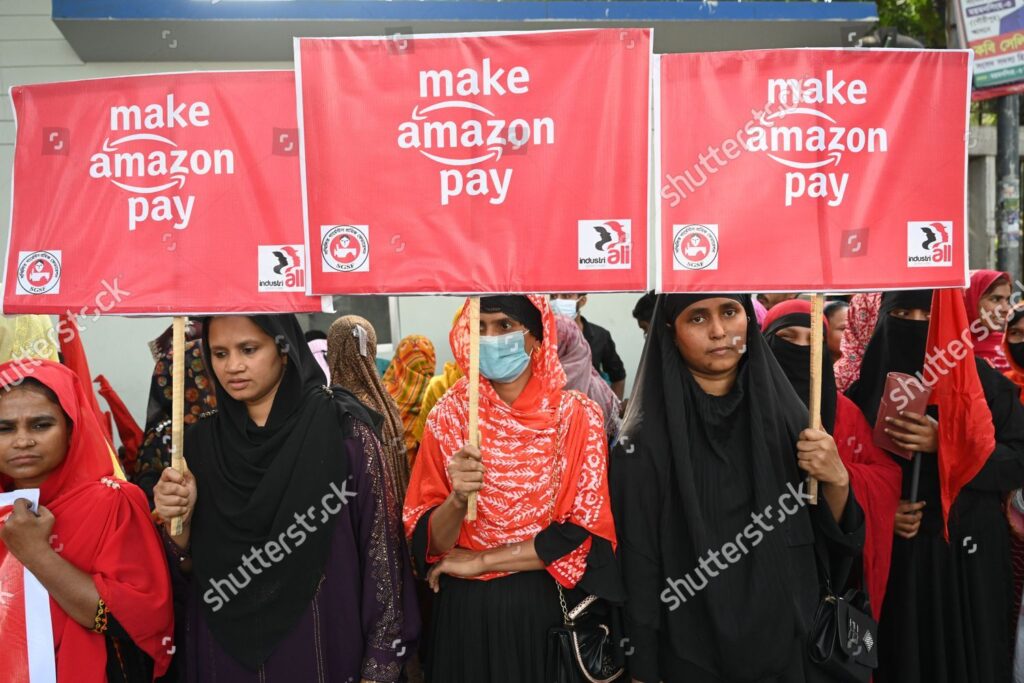
To understand the power of this new internationalism, I reference the “Make Amazon Pay” campaign. The UNI Global Union and the Progressive International united warehouse workers in Alabama, tech workers in Seattle, and textile workers in Bangladesh. The UNI Global Union and Progressive International describe Amazon as an iceberg, with the goal to make the entire iceberg visible. Consumers only see the delivery boxes and their shopping carts, but beneath the surface is a massive, hidden infrastructure of 1,400 factories and hundreds of data centres. As the tech worker in Seattle sits at the tip of this iceberg and the Bangladeshi textile worker remains hidden beneath the surface, they are connected by a single, borderless logic of capital.
Campaigns like these, coupled with the efforts by the GUFs, help to combat the fragmentation of labour which occurs due to the way MNCs operate. Such campaigns further remove the false idea that there is a difference in the interests of a Bangladeshi textile labourer and a Seattle tech worker, since they both are fighting a new techno-feudalist model. By way of automation, the Bangladeshi worker and the Seattle worker are managed similarly: their labour is tracked by digital monitoring systems to watchfully dictate KPIs, where their productivity is reduced to mere numbers. Both struggle against a system that replaces human management with cold, uncompromising metrics as their master. While their daily tasks differ, their vulnerability to global capital is identical, and the labour force has acknowledged that the exploitation is universal and that their interests have been unnecessarily fragmented.
By coordinating strikes against labour abuses, environmental degradation and threats to democracy. and protests on Black Friday across over 30 countries, they have proven that a single corporation may not necessarily be free from union scrutiny behind their national borders. This is global labour unification in action, and it is a unique way to develop labour movements through the unifying effect of the new and ever-developing global economy.
THE GLOBAL SOUTH AS THE FOUNDATION OF THE CONVEYOR BELT
The necessity of GUFs in our world is most evident when we examine the “primary” end of the conveyor belt: the Global South. In this context, the Global South would include developing economies across Latin America, Africa, and parts of Asia. If the 21st century labour movement is a conveyor belt, the Global South is often where the raw materials and primary labour originate, and yet is the most vulnerable segment of the chain. We can see a pattern in which developed nations are continually exploiting the rare earths, minerals, and the cheaper labour force of the Global South.
The concerning part is that despite how resource-rich the Global South is, it continues to face a disadvantage within the hierarchy of global capital. This is an unfortunate result of the nature of foreign investment, for foreign investment is only worthwhile to the MNC if the host country lowers its local wages. While Foreign Direct Investment (FDI) is certainly influenced by political stability and infrastructure, there remains a documented pressure on developing nations to suppress wages to attract capital. The GUF mechanism now becomes crucial by challenging this phenomenon with GFAs. These agreements ensure that an MNC cannot simply move production from one country to another to escape labour standards. By standardizing the dignity of the labourer across borders, GUFs ensure that the Global South is no longer the weak link that capital uses to undercut the bargaining power of workers in the developed world.
MNCs also tend towards the incorporation of artificial intelligence in their operations worldwide, and while they are advertised to be protective of labourers from more dangerous tasks, potential risks arise anyway. Due to a potential over-dependency on artificial intelligence, the gateway to workplace safety and health risks will open. According to the International Labour Organisation, in the manufacturing sector which is prevalent in the Global South, human oversight may decrease, leading to accidents where robotics and heavy machinery are most used. To make matters worse, if KPIs are dictated by artificial intelligence and are imposed on the manufacturing labourer, the likelihood of worker burnout and overworking would increase. These factors create a dangerous concoction for the worker’s security and interests, which further necessitates the importance of GUFs.
For a local union, fighting a system controlled by an office thousands of miles away is an impossible task. GUFs act as the technical and legal connecting agent, allowing workers in the Global South to leverage the collective power of the entire global movement, ensuring that the benefits of globalisation are shared, rather than withheld by a certain few powers.
GUFs and workers around the world prove that while a single stick can be easily broken, the inevitable unity of a bundle of sticks will be the most powerful tool at the disposal of the global labour. In a world where capital has no borders, labour can no longer afford to have them either.

Author

You may also like
-
The Imperial Executive: Adaptation or Democratic Risk?
-
The new ‘safe’ risk: Gen Z are treating careers like startups
-
Scrolling Through Life: When Connection Feels Like Isolation
-
Cybersecurity In Singapore: Navigating Global Threats and National Resilience
-
Degrees in Limbo: How 2026 Is Quietly Redrawing the Map of Studying Abroad
