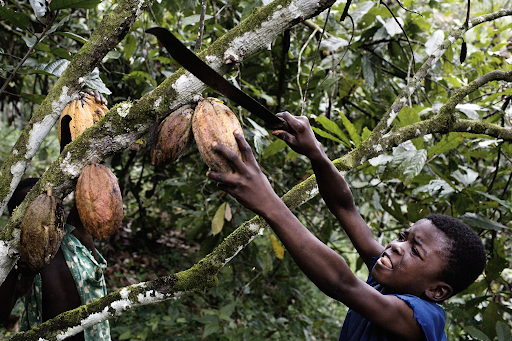
Bitter Chocolate – Daniel Rosenthal: https://www.danielrosenthal.de/ivorycoast/ptch7lfr24zlpy95dzn1ceos6awogx
For much of the Western world, holidays such as Valentine’s Day, Halloween, and Christmas are synonymous with chocolate. This confectionery treat has become the quintessential gift of affection and celebration. Even outside these peak seasons, it remains the global default treat for comfort and indulgence. Yet, beneath the foil-wrapped bar lies a billion-dollar industry fuelled by child exploitation and modern-day slavery, whose ethical foundations are buckling under the weight of systemic abuse.
Chocolate begins with cocoa beans, harvested from cocoa trees. The process is simple but labour-intensive: workers cut ripe pods directly from tree trunks, split them open by hand, extract the cacao beans, and prepare them for fermentation and drying before turning into chocolate. On the surface, the process is straightforward, which begs the question: how did such a simple harvest become the epicentre of a global human rights crisis?
Cacao trees are overwhelmingly concentrated in West African countries, with Côte d’Ivoire and Ghana being the two largest cocoa-growing countries, accounting for 46% of global cocoa production[1]. While these exports are primary economic drivers for West Africa[2], global retailers and manufacturers disproportionately hoard the profit generated. In a staggering shift of wealth, the average farmer’s share of a chocolate bar’s value has plummeted from over 50% in the 1970s to less than 6% today[3]. Even with the global chocolate market valuation close to US$123 billion in 2024[4], the average cocoa farmer’s daily income is roughly US$1.42 in Ghana and US$1.23 in Côte d’Ivoire — well below the extreme poverty line[5]. When a farmer earns only 40% of a living wage, child labour ceases to be a choice and becomes a desperate survival strategy to keep prices competitive in a rigged market.
The poverty trap and the human cost
Currently, more than 1.5 million children work in West African cocoa farms, with many trafficked from neighbouring countries, such as Burkina Faso and Mali, who were lured by false promises or outright abduction[6]. There, the trafficked children are sold to farmers for as little as $34 each[7]. Child labour has been found on cocoa farms in Cameroon, Guinea, Nigeria, and Sierra Leone, although since most of Western Africa’s cocoa is grown in Ghana and the Ivory Coast, the majority of child labour cases have been mostly documented in those two countries[8].
Most cocoa farmers find themselves trapped in a cycle they cannot escape. Limited access to clean water, electricity, infrastructure, or credit constrains productivity. This causes farmers to still operate within a system designed to minimise labour costs while maximising downstream profits. Climate change has only deepened the crisis, with shrinking harvests and amplifying volatility, resulting in a production model that externalises risk onto the poorest actors in the supply chain.
On accountability (or lack thereof)
Behind a veil of corporate secrecy, the chocolate industry has perfected the art of ‘performative accountability’ by offering selective transparency, ensuring that the most basic question “who picks the cocoa?”, remains conveniently unanswered. Rather than arriving through a decisive reform, accountability in the cocoa industry often emerged in fragments, only to be diluted or withdrawn as scrutiny intensifies.
In the early 2000s, efforts to highlight systematic inequality within the cocoa supply trade were often met not with institutional reform, but with repression. A journalist covering corruption in the cocoa industry was allegedly kidnapped by a group connected to the Ivorian First Lady[9][10]. Six years later, Ivorian authorities detained three journalists after they published reports detailing corruption within the cocoa sector[11]. While definitive causation is difficult to establish, these accounts of suppression of investigative reports point to a broader pattern. In which, any challenges to the cocoa industry — an industry seemingly deeply intertwined with political and commercial interests — were met with coercion rather than reform.
By the early 2010s, major chocolate manufacturers began publicly acknowledging the existence of child labour and slavery within their supply chain. These admissions, however, were rarely followed by structural change; instead, they were rebranded as corporate responsibility programs framed in optimistic but ambiguous terms. In 2010, advocacy groups including the International Labour Rights Forum, Global Exchange and Green America, launched the “Raise the Bar” campaign[12], urging Hershey’s to commit fully to ethically sourced cocoa. Hershey’s response? A pledge to invest $10 million in West African cocoa programmes over five years, which roughly amounted to $2 million annually[13], a modest sum when contrasted with the company’s multi-billion-dollar profits during the same period. Cargill’s “Cocoa Promise,”[14] emphasises sustainability, transparency, and farmer livelihoods within its direct sourcing network, acknowledging that low prices exacerbate poverty and heighten the risk of child labour. Yet evidence that such programmes have meaningfully improved farmer incomes or reduced exploitation remains limited.[15]
The current decade has seen the battle move in the legal system, but with limited success. In 2021, Nestlé USA, Inc. v. Doe[16], the U.S. Supreme Court overturned a lower-court ruling that would have allowed former child slaves trafficked from Mali, to sue Nestlé and Cargill under the Alien Tort Statute ( ATS). The Court held that because the alleged abuses occurred abroad, general corporate decision-making in the U.S. was insufficient to establish jurisdiction. In doing so, the ruling further insulated U.S. multinationals from liability for overseas human rights violations, reinforcing the jurisdictional barriers that continue to frustrate legal redress.
When governments hesitate, corporations promise self-regulation. The results have been underwhelming. Industry-led initiatives and certification schemes, such as Fairtrade Cocoa[17], UTZ-Rainforest Alliance[18] offer limited safeguards while leaving the underlying price structures that keep farmer poverty intact. Consequently, they fail to address the root cause of child exploitation and forced labor: the absence of a living income. A living income is not a moral luxury; it is a human right for farmers to afford food, housing, healthcare, education, and basic security.[19] When only 6 % of a chocolate bar’s profit reaches farmers[20], exploitation becomes structurally inevitable.
Can we ever consume chocolate ethically?
Is the solution simply to stop eating chocolate? Ethical consumption alone cannot dismantle a system in which exploitation remains profitable; shopping ethically is not the ‘heroic’ response to end slavery in the cocoa industry. Individual consumer choices, however well-intentioned, are structurally incapable of correcting an industry built on poverty wages. What distinguishes the cocoa industry is not the absence of promises, but the absence of consequences. Accountability, where it exists at all, has amounted to little more than a slap on the wrist: voluntary commitments, opaque audits, and certification schemes that function even when no one is watching.
Real change requires shifting the economics of cocoa itself. Regulation will matter only if it carries teeth: transparent pricing, liability for overseas abuses, and penalties severe enough to make exploitation unprofitable. Until a farmer earns four to five times their current rate, child labour will remain baked into the system. Until then, the ‘sweet’ treat will continue to have a bitter, exploited core.

Author

You may also like
-
The Imperial Executive: Adaptation or Democratic Risk?
-
The new ‘safe’ risk: Gen Z are treating careers like startups
-
Scrolling Through Life: When Connection Feels Like Isolation
-
Cybersecurity In Singapore: Navigating Global Threats and National Resilience
-
Degrees in Limbo: How 2026 Is Quietly Redrawing the Map of Studying Abroad
