At around 9.35pm ET on the 5th of November, cheers erupted in the streets of New York City. For the thousands of New Yorkers who were gathered in clubs, bars and theatres that night, or who sat with bated breath in front of their televisions at home, this moment was pivotal. Their ballots had been cast — the future was written. In the morning, their new mayor would take City Hall.
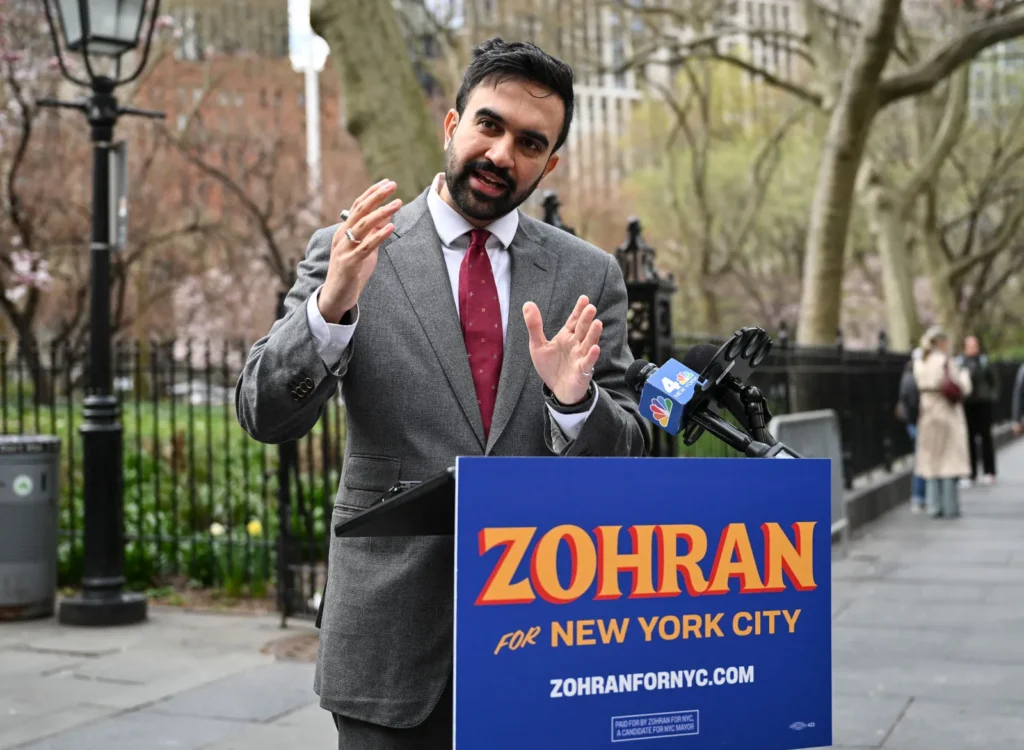
34-year old Zohran Mamdani’s mayoral victory is historic on multiple fronts. As New York City’s first millennial, South Asian and Muslim mayor, many hail his victory as a celebration of the culturally diverse voices that characterise New York City and call the city home.
However, his is far from just a diversity win. To Americans across the nation and political spectators worldwide, Mamdani’s victory marks a key shift in the dynamics of American politics.
The Democratic Party has long shied away from “progressive” voices, preferring instead to campaign on economically moderate stances in order to appeal to the swing voters who waver across partisan lines. When Mamdani, a self-proclaimed Democratic Socialist, continued to campaign on ambitiously left-wing policy proposals, he faced disapproval and skepticism from many centrist-leaning Democratic leaders. Yet the voters speak for themselves. Mamdani’s dazzling victory arc — from a little-known state assemblyman to the mayor-elect of the richest city in the world — points to one glaring truth: voters are no longer satisfied with the status quo, and the Democratic Party must adapt.
So, what exactly is Democratic Socialism and why was it ever so unpopular?
Democratic socialist ideology is closely associated with the progressive left, and has long been frowned upon by both Republicans and moderate Democrats. In fact, a big reason for the animosity is in the name — socialism. In fact, President Donald Trump himself was once a key contributor to this stigma, famously calling Mamdani a “communist” whose victory is “a terrible thing for our country” — although Trump appeared to rescind his hostility at their recent press conference meeting on 22 November.
However, the Democratic Socialists of America (DSA) — the largest socialist organisation in the US — does not associate themselves with authoritarian socialist regimes. Their ideology claims to rejuvenate democracy by empowering communities from the ground-up, putting political power in the hands of the people. It also criticises present-day capitalism as an exploitative system, which takes advantage of the working class and the environment in order to turn a profit for “the owning class”. The DSA has endorsed key political candidates such as Bernie Sanders, Alexandria Ocasio-Cortez, and most recently Zohran Mamdani.
Mamdani’s promises to put the people in power has been the rallying cry of his campaign thus far. Though, of course, to “put the people in power” is a deceptively easy promise to make — one that has been made and broken countless times before. In America’s self-assured democracy, it would be difficult for any politician to come into power without taking a populist stance.
The idea of American democracy, however, is where things get murkier.
Political analysts and social justice advocates around the world argue that modern-day dictatorships can look a little different from the way they did in the twentieth century. In fact, if any political layperson were to sit down with the new mayor-elect himself — or any one of his colleagues at the DSA — they would likely be introduced to the term oligarchy.
An essential pillar of the Democratic Socialist argument is that America is rapidly devolving into an oligarchy: an unjust system where vast political and economic power is concentrated in the hands of the top 1%, thereby undermining the democratic freedoms of the common folk. Many political analysts and international organisations have long rallied behind this argument. Trump’s administration seems only to worsen the problem — Trump’s Big Beautiful Bill appears to persistently prioritise corporate interests at the expense of welfare — slashing MedicAid, food and housing assistance, while handing out tax breaks for the billionaires at the top of the economic food chain. Analysts have estimated that these healthcare cuts can result in over 50 000 deaths nationwide. From the president who championed white working-class Americans in his rise to power, this seems like a flagrant betrayal. Is this flagrant inequality truly part and parcel of the capitalist system that drives the American dream? Are those 50 000 citizens simply the sacrifice that must be made in the name of economic progress?
It is not difficult to recall Trump’s billionaire-studded Cabinet throughout both presidential terms, or the corporate lobbying that helped put Barack Obama into office — including millions raised by lobbyist ‘bundlers’ from the health-insurance, software, and telecom sectors.Putting it all into context with the rampant opioid crisis all over urban and rural America, the years-long waiting times for a bed in a homeless shelter, or the soaring cost of living that permeates various aspects of the economy and hits hardest on its lower rungs — something is truly and deeply wrong. As such, many political analysts have also likened this to a plutocracy. In a plutocratic system, the government is ruled by the wealthy, who manipulate the system in order to continue accruing wealth — all at the expense of the common citizen. In this way, democracy comes under the reins of the wealthy, and political power is up for sale.
However, maybe the most chilling of all is this — it was never just a Trump problem. In fact, the dystopian tale of America’s plutocracy began a long time ago. It can be traced back to Reagan’s neoliberal reforms in the 1980s, and has remained embedded in the American economy throughout both Republican and Democratic administrations. The Democrats’ step to the right was marked by Clinton’s administration and his introduction of the “Third Way” — an economic strategy that claimed to champion public investment whilst opening up the American economy to globalisation.
Along with pressures from the changing economy, working class voters felt snubbed by the government. The Democratic Party and its liberal agenda came to be viewed as the party of the elite. The fuel was there – it needed only the spark.
Donald Trump, with his protectionist calls-to-action and promises to Make America Great Again, lit this spark in 2016 and then again in 2024. He promised to fix the broken economy — and yet these promises appear more like deceptions. The plutocracy persists.
It doesn’t take a genius to acknowledge that something is very wrong. The real money is on the question: who will actually fix it?
Within New York City itself, the mantle has fallen on Mayor-elect Zohran Mamdani.
Mamdani’s campaign
In one short year, Mamdani rose from a trailing political hopeful to the youngest mayor-elect New York City has ever had. The outcome of his campaign was astonishing. Policy analysts around the world marvel not just at its resounding success, but in the refreshing rhetoric of community that Mamdani employed to rally the city in his favour — a strategy that centered around human connection and empowerment. Yet this bottom up momentum stood in sharp contrast to how the Democratic establishment reacted.
A lot of mainline Democrats have been noticeably shy about Mamdani’s candidacy, with top party leaders barely acknowledging his campaign. New York’s two senators, Chuck Schumer and Kirsten Gillibrand, kept their distance and avoided any public endorsement. Neither did Hakeem Jeffries, the House minority leader who represents a Brooklyn district, despite having worked with Mamdani to alleviate taxi drivers’ debt.
Meanwhile, the progressive wing didn’t hesitate. Figures like Alexandria Ocasio-Cortez and Bernie Sanders stepped in, with Sanders himself publicly endorsing Mamdani at a rally back in October.
However, Mamdani’s greatest support came from the people themselves — something very visible in his online presence. True to form as a millennial, Mamdani ran an electrifying social media campaign. Within the year, he amassed millions of followers across various platforms including Instagram, YouTube and Tiktok. Mamdani’s team generated a steady stream of campaign content in seemingly tireless succession, each post sporting the same key elements: Mamdani in his characteristic suit-and-tie and sunny grin, with a dash of slapstick humour. — all presented palatably for both audience and algorithm. His campaign visuals channeled Metrocard yellow, Mets blue, and classic bodega-style hand-lettered signage, creating an instantly iconic New York look.
However, that is not to say that his only strength is in social media. A huge part of Mamdani’s campaign was, notably, that he was constantly outside. Be it doing tai-chi with a group of seniors, walking the entire length of Manhattan, canvassing the taxi line at LaGuardia airport, or tussling with state troopers in protest of the detention of Columbia student Mahmoud Khalil — Mamdani was constantly visible and always active. By the end of his campaign, he had amassed over 100,000 volunteers, with whom he knocked on doors to preach a different kind of politics: one that turns away from corporate interests, championing the working class instead. The mainstay of his policy proposals was to increase taxes on the top earners of New York City – namely those earning over $1 million a year. In an interview with ABC News, he outlined how this plan would generate $9 billion dollars annually to boost working-class New Yorkers. This would come in the form of free bus services, free childcare, and five state-owned grocery stores that would help cushion the rising cost of living.
Mamdani rallied his campaign to victory with the power of community — or, as the Guardian’s Ed Pilkington aptly stated, “by simply getting New Yorkers to talk to each other”.
If he makes good on his promises, New York City is poised to finally undermine the plutocratic capitalism that has held sway over the city for decades.
No matter where a New Yorker might stand on the political spectrum, the people’s endorsement of Mayor Mamdani has made one thing clear: the city is hungry for change. America’s long history of divisive politics is getting old. Millions of Americans across all demographics champion Mamdani as a beacon of hope for a fairer democracy. Now, in order to truly set himself apart from the oligarchs he opposes, he must deliver on his promises.
The spotlight now turns to other Democratic endeavours across the country. Once the political spearhead of individual liberty and diversity, the blue party now lags behind in favourability ratings. Is Mamdani’s victory an isolated case, or is it only the first sign of large-scale change?

Author

You may also like
-
The Imperial Executive: Adaptation or Democratic Risk?
-
The new ‘safe’ risk: Gen Z are treating careers like startups
-
Scrolling Through Life: When Connection Feels Like Isolation
-
The Conveyor Belt that is the 21st century labour movement
-
Nothing Tastes as Decadent as Child Exploitation: Systemic Slavery in the Cocoa Industry
