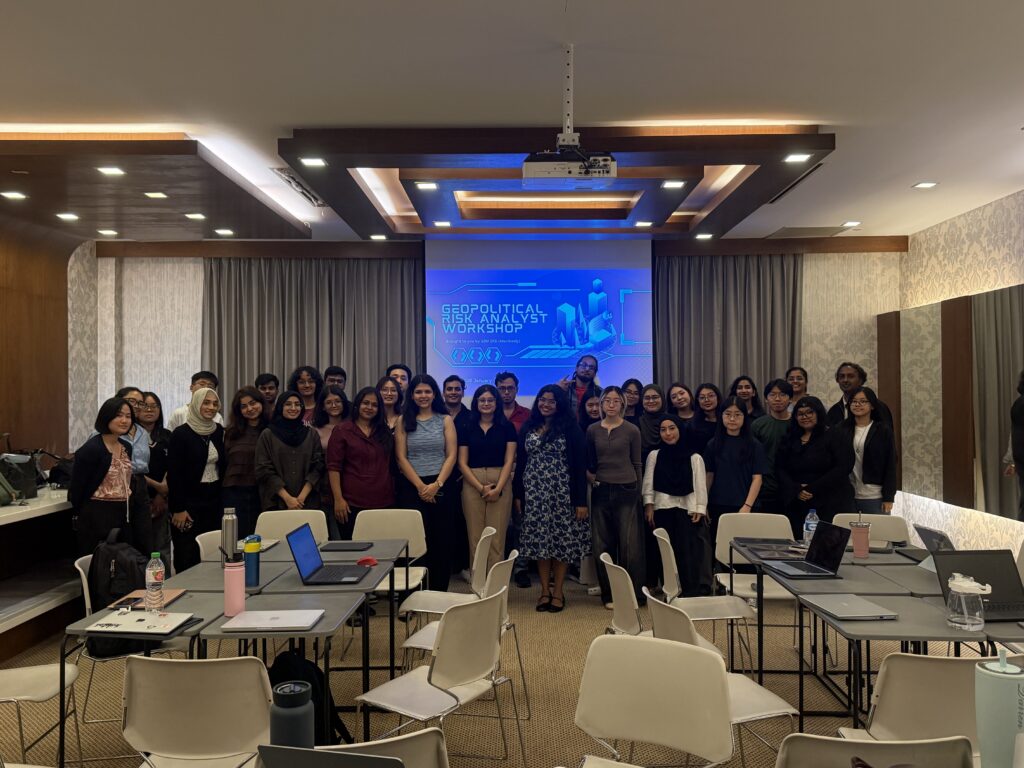
Our current geopolitical environment is continuously coming under crisis. With an increase in fragmentation and power competitions, the safety of geopolitics has come under question. Who is safeguarding its interests? On January 20, Singapore Institute of Management (SIM) students sat with 3 distinguished professionals to understand the scope of their work as geopolitical risk analysts and the measures that they’ve undertaken as a part of their job to safeguard the geopolitical climate.
What are geopolitical risks?
To get a deeper understanding of the nature of the risks, Aishwarya S, an Analyst at the Global Threat Analysis Centre (GTAC) at Warner Bros. Discovery was able to provide some insight.
Geopolitical threats are defined as anything that disrupts people, sites, data, brand and supply chains. In this day and age, there has been a rise of non-traditional threats that go beyond merely war and terrorism. These non-traditional threats include political instability, disinformation, A.I. risks, sanctions, and many more.
This comes to show that the nature of geopolitical threats no longer require physical violence to be dangerous. In this situation, the work of analysts becomes pivotal because they monitor threats inside of political, social and security environments and help to connect global events to actionable business decisions.
As an analyst, they’re tasked to decipher these threats into effective signals for their stakeholders. Without these transmitted signals, companies can suffer a hit to their revenue, safety and trust. In times of crisis, analysts provide communication to help businesses cope and recover effectively.
Take the COVID-19 pandemic for example, a health pandemic that gradually transformed into a multi-level global crisis. Misinformation spread like wildfire from media sources and as crisis communicators, analysts were tasked to sift through the plethora of information to determine what was credible and confirmed before disseminating it to stakeholders. It was an event with cascading effects because while fear was reasonable, it was also due to the sheer exacerbation of the event by the media and misinformation.
How are analysts sending this information out?
Amidst the exchanged airstrikes in India and Pakistan in May 2025, we saw the militarisation of A.I. to spread misinformation. This was seen through the use of deepfakes, where a video of Pakistan’s Prime Minister, Shehbaz Sharif, was edited to appear as if he were admitting defeat. The video used AI voice mimicry and lip-sync technology to deliver a speech that was entirely fabricated, and yet disturbingly believable. Therefore, in instances as such, the ability to disseminate accurate information is critical.
To explain this, Supervisor of APAC and Global Security Control Centre Disney, Drishti Prajapati, took over. She distinguishes the way these events are being categorised and the development process that analysts take to respond accordingly.
Situations are categorised to be either incidents, issues or crises. An incident would mean that the disruption is manageable. An issue would mean that it concerns reputational or regulatory risks, such as policy changes in organisations, boycotts or campaigns. Lastly, crises refers to board-level, time sensitive threats. By classifying these threats, analysts can decide how to develop their response一strategically or tactically.
Strategically developing a response would imply doing more monitoring before implementing it. In 2026, Malaysia is due to erect a law on the use of social media by banning the use of social media for children under the age of 16. An initiative like this is a strategic development that analyses the repercussions of their choice in the long term before deciding on it.
Tactically developing a response would suggest tackling the situation immediately. In circumstances as such, time is of the essence, which automatically categorises the threat as something volatile and life-threatening, such as mass shootings, protests or war outbreaks. This would mean that tactical briefs would have to go out in a shorter span of time to ensure that action can be taken sooner. These briefs could include orders pertaining to the closure of borders or travel advisories for civilians. It is crucial that these briefs are concise and precise with specific information and they’re solely meant for immediate or short term purposes.
For example, in the Bondi Beach shooting that occurred in Sydney, Australia, analysts were tasked with the duty of swiftly conducting real-time monitoring and sharing information with Non-Governmental Organisations (NGOs), employees based in Sydney, and any corporate travellers that were travelling to Sydney from different regions.
What are some examples of geopolitical risks that have taken place recently?
Modern geopolitical conflicts that arose under non-traditional circumstances include Russia and Ukraine, with their conflict about oil supply, US-China, with sanction regimes and export controls and Israel-Palestine, with their century-long dispute over land. There has also been the Red Sea shipping disruptions, which occurred as a result of Houthi attacks on vessels since late 2023.
What do geopolitical analysts do?
Similar to doctors assessing a patient for treatment, Threat Analyst at Walt Disney Companies Asia-Pacific Security Control Centre, Vaishnavi Devarajan, describes her work as such. She labels this part of their job as “alerting triage”, where one of their main duties lies in identifying, assessing and alerting stakeholders. This is done through Open-source Intelligent (OSINT) monitoring.
To provide analysts with the access to resources that they need to work, most organisations, including risk consultancies, are subscribed to intelligent services, newsletters, and resources. This allows them to create situation reports and briefings.
In addition to this, they’re also tasked with coordinating with cross-functional teams such as Security Operations Centres (SOC) and fusion centers in the event of a crisis. These two branches are mutli-agency hubs that are in charge of cyber, physical and geopolitical monitoring that helps to detect, prevent, and respond to an incident or crisis.
Can they be displaced by A.I.?
Simply put, no. When receiving an ample amount of data, A.I. struggles to adapt to change especially when the inflow of information continues to develop as a crisis escalates. Despite the ability of a Large Language Model (LLM) to filter, segregate and identify the nature of the information, it is mainly a supplement to the human judgement that goes into being an analyst. An analysts’ judgement prevents automation bias, and allows for the observation and correction of dataset models that recognise patterns, learn from them, and make predictions or decisions on new data.
The networking abilities of modern human intelligence cannot be replicated by A.I., which happens to be a large portion of being an analyst due to the importance of them keeping close communications with local teams and consultants, NGOs, embassies and chambers of commerce.

Author

You may also like
-
The Imperial Executive: Adaptation or Democratic Risk?
-
The new ‘safe’ risk: Gen Z are treating careers like startups
-
Scrolling Through Life: When Connection Feels Like Isolation
-
Cybersecurity In Singapore: Navigating Global Threats and National Resilience
-
Degrees in Limbo: How 2026 Is Quietly Redrawing the Map of Studying Abroad
